
Ankle Sprains
& Instability
From acute lateral sprains to chronic ankle instability, Dr. Katz combines precise diagnostic imaging with regenerative therapies — PRP, functional bracing, and proprioceptive rehab — to restore full strength without the revolving door of recurring injuries.

are lateral
What Is an Ankle Sprain?
An ankle sprain occurs when the ligaments that stabilize the ankle joint are stretched or torn — most often when the foot rolls inward during landing, cutting, or stepping on an uneven surface. The anterior talofibular ligament (ATFL) is the most commonly injured structure, followed by the calcaneofibular ligament (CFL).
Ankle sprains are the most common musculoskeletal injury in athletes — and one of the most under-treated. When the initial injury is managed with “rest and ice” alone, without addressing ligament integrity and neuromuscular retraining, up to 30% of patients develop chronic ankle instability: a cycle of recurrent giving-way, cartilage damage, and eventual arthritis.
- Most common sports injury — over 50% of sprains are sports-related
- ATFL is injured in 70–85% of lateral ankle sprains
- Grades 1, 2, and 3 require different treatment intensities
- 5–30% still have pain & instability at one year without proper rehab
- Osteochondral lesions found in up to 50% of chronic instability patients
- PRP reduces recurrence risk by 40–50% with targeted delivery
Conditions We Treat
Dr. Katz treats the full spectrum of ankle ligament injuries — from first-time acute sprains to complex chronic instability requiring surgical reconstruction.
Chronic Ankle Instability — Our Most Underdiagnosed Presentation
Chronic ankle instability (CAI) is defined as repeated episodes of the ankle “giving way” — especially on uneven terrain or during sport — occurring more than 12 months after an original sprain. It arises when ligament damage is incompletely healed and proprioceptive pathways are not restored. Clinical studies show roughly one in three ankle sprains will recur, and that up to 30% of patients develop true CAI within a year. Left untreated, CAI accelerates cartilage wear and leads to post-traumatic arthritis. At Katz Regenerative Foot & Ankle, CAI is our primary indication for ultrasound-guided PRP combined with structured neuromuscular rehabilitation — and for Broström-Gould reconstruction when mechanical laxity persists.
The Three Grades of Ankle Sprains
Treatment intensity is matched to ligament damage. Grading at the first visit determines whether conservative care, PRP, bracing, or surgery is appropriate.
Mild — Ligament Stretched
- Microscopic tears; ligament structurally intact
- Mild swelling and tenderness; weight-bearing possible
- Minimal or no joint laxity on stress testing
- Recovery: 2–4 weeks with functional treatment
Moderate — Partial Tear
- Partial disruption of ligament fibers
- Moderate swelling, bruising, and some laxity
- Painful weight-bearing; functional brace often needed
- Recovery: 6–12 weeks; PRP significantly accelerates healing
Severe — Complete Rupture
- Full-thickness ligament tear; significant mechanical instability
- Marked swelling and bruising — sometimes paradoxically less painful
- Positive anterior drawer and talar tilt stress tests
- Recovery: 12+ weeks; surgical reconstruction if conservative care fails
How Dr. Katz Treats Ankle Sprains
Comprehensive Evaluation & Imaging
Dr. Katz performs a detailed biomechanical exam including anterior drawer and talar tilt stress tests to assess ligament integrity. Digital X-rays rule out fracture; musculoskeletal ultrasound or MRI is ordered when ligament, tendon, or osteochondral damage is suspected. Ottawa Ankle Rules guide imaging decisions for same-day clarity.
Acute Phase Management
The first 24–72 hours focus on controlling swelling and protecting the joint. Dr. Katz customizes a PRICE protocol (Protection, Rest, Ice, Compression, Elevation) and may apply an Aircast walking boot or functional brace. For Grade 2–3 tears with significant laxity, PRP injection can be administered within the acute window to accelerate ligament healing before scar tissue forms.
Regenerative Rehabilitation
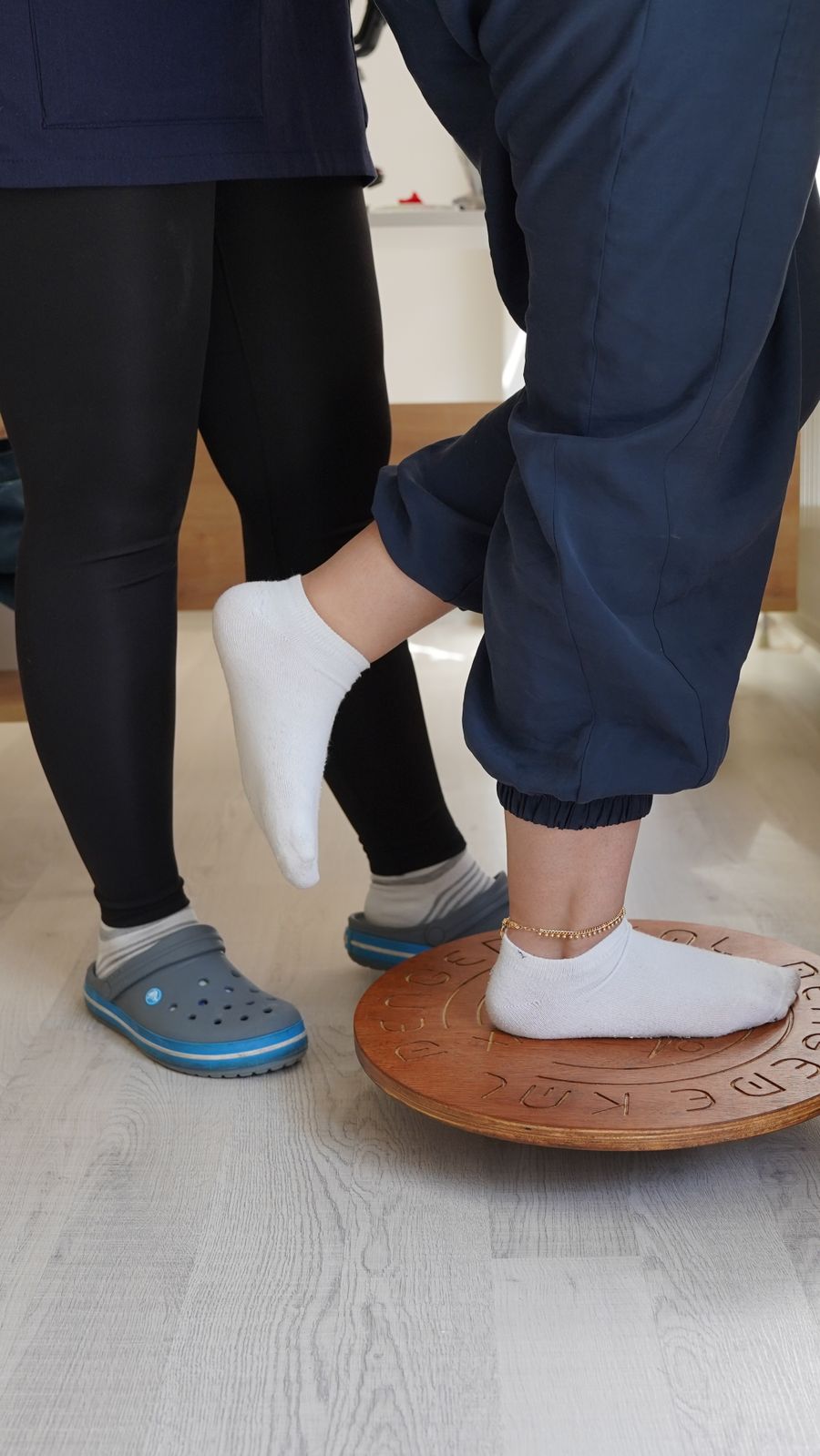
Once acute swelling subsides, structured rehab begins: proprioception and balance retraining on wobble boards, progressive peroneal strengthening, and manual joint mobilization to restore range of motion. For persistent pain or instability, ultrasound-guided PRP injections are delivered directly to the injured ligaments — stimulating collagen repair and reducing recurrence risk by up to 40–50%.
Return to Activity & Long-Term Protection
Clearance for sport returns only after functional tests confirm full strength, balance, and agility. Custom ankle-foot orthotics are fabricated using 3D scanning to correct the biomechanical patterns that contributed to the original injury. For true chronic instability unresponsive to conservative care, minimally invasive Broström-Gould ligament reconstruction is offered with same-day surgery and accelerated recovery.
Should You Come In?
Not every sprain requires surgery — but all significant sprains deserve a proper evaluation. See whether your situation warrants an urgent or elective visit.
Come in promptly if you have:
- ✓Inability or difficulty bearing weight after the injury
- ✓Significant swelling, bruising, or deformity
- ✓Tenderness directly over a bone (possible fracture)
- ✓Ankle that “gave out” during normal walking
- ✓Prior sprain on the same ankle — even if it “healed”
- ✓Lingering pain or instability more than 6 weeks post-injury
- ✓Popping or snapping sensation in the ankle with movement
Signs it may be Grade 1 (monitor at home):
- ✕Mild tenderness only — no swelling or bruising
- ✕Full weight-bearing immediately after the twist
- ✕Pain resolving within 24–48 hours
- ✕No prior history of ankle sprains
- ✕No bony tenderness along the malleolus
- ✕Normal range of motion within 1–2 days
Ankle Sprain FAQ
How do I know if my ankle is sprained or broken?
The Ottawa Ankle Rules — a validated clinical decision tool — help determine when X-rays are necessary. Pain or tenderness directly over the lateral or medial malleolus (the bony bumps on either side of the ankle), inability to bear weight immediately after the injury or in the office, or point tenderness over the navicular or base of the fifth metatarsal are indications for imaging. However, many severe Grade 3 ligament tears cause less immediate pain than fractures, because the ligament is completely disrupted and no longer under tension. The only reliable way to distinguish a sprain from a fracture — or to assess the degree of ligament damage — is a clinical exam with targeted imaging. At Katz Regenerative Foot & Ankle, we perform digital X-rays on-site and can order musculoskeletal ultrasound or MRI at the same visit. Do not rely on pain level alone: a sprain that 'doesn't hurt that much' can still represent a complete ligament tear requiring structured treatment to prevent chronic instability.
What are the three grades of ankle sprains and why does it matter?
Ankle sprains are classified on a three-grade scale that directly drives the treatment plan. Grade 1 sprains involve microscopic tearing of ligament fibers — the ligament is stretched but structurally intact. There is mild swelling and tenderness, and most patients can bear weight. Grade 1 sprains typically resolve with a structured PRICE protocol and targeted exercises over two to four weeks. Grade 2 sprains represent partial ligament tears with moderate swelling, bruising, and some joint laxity. Recovery takes four to eight weeks and benefits significantly from a functional brace, physical therapy, and in some cases PRP injection to accelerate healing. Grade 3 sprains are complete ligament ruptures. The joint is mechanically unstable, with significant swelling and bruising — sometimes paradoxically less painful than Grade 2 because the ligament can no longer transmit tension signals. Without proper rehabilitation, Grade 3 sprains frequently develop into chronic ankle instability, a condition where the ankle 'gives way' repeatedly, predisposing to osteochondral lesions and early arthritis. Dr. Katz grades every sprain at the first visit to ensure the treatment intensity matches the actual tissue damage.
What is chronic ankle instability and how is it treated?
Chronic ankle instability (CAI) develops when a sprained ankle does not heal with sufficient mechanical and neuromuscular integrity. It is defined clinically as repeated episodes of 'giving way' — the ankle rolling inward unexpectedly during walking, sport, or even on flat ground — typically occurring for more than 12 months after the initial injury. Studies report that 5–30% of ankle sprain patients still experience pain and instability after one year, and roughly one-third of sprains recur. CAI involves two overlapping problems: mechanical laxity (the ligaments are structurally elongated or torn) and functional instability (impaired proprioception — the joint's ability to sense its own position). Effective treatment must address both. At Katz Regenerative Foot & Ankle, the first-line approach is regenerative rehabilitation: ultrasound-guided PRP injections to stimulate ligament remodeling, combined with a structured proprioceptive training program using balance boards and sport-specific agility drills. Custom orthotics correct the underlying biomechanical patterns. When true mechanical laxity persists despite six or more months of conservative care, minimally invasive Broström-Gould lateral ligament reconstruction provides reliable long-term stability with a return-to-sport timeline of four to six months.
Can PRP injections really help a sprained ankle heal faster?
Yes — and the timing matters. Platelet-Rich Plasma (PRP) is a concentration of your own growth factors (PDGF, TGF-β, VEGF, IGF-1) extracted from a small blood draw and spun in a centrifuge. When injected under ultrasound guidance directly into a torn ligament, these growth factors accelerate the cellular repair cascade: stimulating fibroblast proliferation, promoting collagen synthesis, and increasing neovascularization. For acute Grade 2–3 sprains, early PRP injection — ideally within the first one to two weeks — can shorten recovery time, reduce the rate of scar tissue formation, and meaningfully lower the risk of progressing to chronic instability. For established chronic instability with ligament laxity, PRP promotes collagen remodeling in a ligament that has already scarred, improving tissue quality even years after the original injury. Dr. Katz uses the EmCyte Pure PRP system, which produces platelet concentrations consistently four to seven times baseline with minimal red blood cell contamination — the preparation profile shown in the literature to produce the most robust tissue-healing response.
How long does it take to fully recover from a serious ankle sprain?
Recovery timelines vary substantially by grade, treatment approach, and individual biology. For Grade 1 sprains with appropriate functional treatment, most patients notice significant improvement within the first two weeks and return to normal activity by four to six weeks. Grade 2 sprains treated with a functional brace, PRP, and structured rehabilitation typically resolve in six to twelve weeks, though full restoration of proprioception can take three to four months. Grade 3 sprains — complete ligament ruptures — require the most patience: clinical studies report a mean return to full sports participation of approximately 12.9 weeks with optimized conservative management. Patients who develop chronic instability and require Broström-Gould reconstruction should plan for a four-to-six-month rehabilitation course before clearance for high-demand activity. One of the most common errors Dr. Katz sees is patients returning to sport too quickly after a significant sprain, before proprioceptive training is complete. Premature return is the leading driver of re-injury and the transition from acute sprain to chronic instability. Functional testing — not elapsed time alone — determines true readiness.
What happens if I ignore a sprained ankle and just walk it off?
Untreated or undertreated ankle sprains carry real long-term consequences that are frequently underestimated. The two most significant risks are chronic ankle instability and osteochondral lesions. Chronic instability develops when the ligaments heal with insufficient structural integrity — the scar tissue that forms is mechanically weaker than the original ligament, and without targeted rehabilitation, the joint's proprioceptive pathways are not restored. This creates a cycle of recurrent sprains, each one potentially causing additional cartilage damage. Osteochondral lesions — areas of cartilage and underlying bone damage — are found in up to 50% of chronic instability patients and are a known precursor to post-traumatic ankle arthritis. Studies show that 5–30% of ankle sprain patients still have pain and functional limitations one year later. The good news is that the window for optimal regenerative treatment is widest in the first weeks after injury. If you have significant swelling, bruising, or difficulty bearing weight after a sprain, an evaluation within the first few days — rather than the traditional 'wait and see' — gives you the best chance of full recovery without sequelae.
Often combined with sprain treatment
Related Treatments
Sprained your ankle? Don't wait for it to ‘walk off.’
Most patients who develop chronic ankle instability did so because their original sprain was undertreated. Book an evaluation with Dr. Katz within the first week for the best chance at a full recovery — and to prevent the next one.